Pages 1 - 3: Locker Puzzle (In-Text Questions)
How did Khoisnam figure out which lockers remain open ?
Solution :
A locker's state (open or closed) is toggled every time a student interacts with it.
- A locker will be in the open state at the end only if it has been toggled an odd number of times. (Starting closed, toggle 1 = open, toggle 2 = closed, toggle 3 = open, etc.)
- A locker will be in the closed state at the end only if it has been toggled an even number of times.
- Most numbers have divisors that come in pairs. For example, for the number 12, the pairs are (1, 12), (2, 6), and (3, 4). This results in an even number of divisors (6 in this case).
- Non-perfect squares have their divisors paired up, resulting in an even number of divisors (e.g., 6 divisors for 12, and 4 divisors for 10). They will be closed.
- Perfect squares have odd factors (e.g., 9: (1×9), (3×3) means 3 divisors for 9: 1, 3 and 9; → odd count).
- Perfect squares have an odd divisor left over after pairing (the square root), resulting in an odd number of divisors (e.g., 3 divisors for 4: 1, 2, 4; and 5 divisors for 16: 1, 2, 4, 8, 16). They will be open.
Lockers 1, 4, 9, 16, 25, 36, 49, 64, 81, 100 remain open (10 lockers).
Does every number have an even number of factors?
Solution :
For a general integer $ N $
- The factors (or divisors) of $N$ usually come in pairs $(a, b)$ such that $a \times b = N$
- Example: For $N=10$, the factor pairs are $(1, 10)$ and $(2, 5)$. This gives $2 + 2 = 4$ factors (an even number).
The Exception: Perfect Squares
- Perfect squares have odd factors (e.g., 9: (1×9), (3×3) means 3 divisors for 9: 1, 3 and 9; → odd count).
- Perfect squares have an odd divisor left over after pairing (the square root), resulting in an odd number of divisors (e.g., 3 divisors for 4: 1, 2, 4; and 5 divisors for 16: 1, 2, 4, 8, 16).
No, not every number has an even number of factors.
The numbers that have an odd number of factors are the perfect squares.
Which are these five lockers? (Toggled exactly twice, i.e., primes.)
Solution :
Toggled twice: Exactly two factors (1 and itself) → prime numbers.
Since each prime number has 1 and the number itself as factors.
So, First five primes: 2, 3, 5, 7, 11
Page 4 :Squares Table (In-Text Activity)
Find the squares of the first 30 natural numbers and fill the table.
Solution :
The squares of the first 30 natural numbers.
n
n²
n
n²
n
n²
1
1
11
121
21
441
2
4
12
144
22
484
3
9
13
169
23
529
4
16
14
196
24
576
5
25
15
225
25
625
6
36
16
256
26
676
7
49
17
289
27
729
8
64
18
324
28
784
9
81
19
361
29
841
10
100
20
400
30
900
What patterns do you notice? Share your observations and make conjectures.
Solution :
All perfect square numbers end with 0, 1, 4, 5, 6, or 9, and none of them end with 2, 3, 7, or 8.
We see that the next perfect square is the sum of next consecutive odd number
Example : Sum of first n odd numbers = n² (e.g., 1 + 3 +5 = 9 = 3²).
Conjecture: Squares preserve parity; units digit rule holds.
If a number ends in 0, 1, 4, 5, 6, or 9, is it always a square?.
Solution :
A number ending in 0, 1, 4, 5, 6, or 9 is not always a perfect square.
Examples of Non-Squares: Here are examples of numbers ending in those digits that are not perfect squares:
Ends in 0: The number $\mathbf{10}$ is not a square
Ends in 1: The number $\mathbf{11}$ is not a square
Ends in 4: The number $\mathbf{14}$ is not a square
Ends in 5: The number $\mathbf{15}$ is not a square
Ends in 6: The number $\mathbf{6}$ is not a square
Ends in 9: The number $\mathbf{19}$ is not a square
Write 5 numbers such that you can determine by looking at their unit digit that they are not squares.
Solution :
The unit digit of a perfect square can only be $\mathbf{0, 1, 4, 5, 6,}$ or $\mathbf{9}$.
Therefore, if a number ends in $\mathbf{2, 3, 7,}$ or $\mathbf{8}$, it is guaranteed not to be a perfect square.
Examples : Here are 5 numbers that cannot be perfect squares, determined solely by their unit digit:
63, Ends in 3: Perfect squares never end in 2, 3, 7, or 8.
47, Ends in 7: Perfect squares never end in 2, 3, 7, or 8.
18, Ends in 8: Perfect squares never end in 2, 3, 7, or 8.
22, Ends in 2: Perfect squares never end in 2, 3, 7, or 8.
237, Ends in 7: Perfect squares never end in 2, 3, 7, or 8.
Page 5 : Units Digits and Zeros
Which of the following numbers have the digit 6 in the units place?
(i) $38^2$ (ii) $34^2$ (iii) $46^2$, (iv) $56^2$, (v) $74^2$
Solution :
A square will have a unit digit of 6 if the original number's unit digit is 4 or 6, because
$4 \times 4 = 16$ (ends in 6)
$6 \times 6 = 36$ (ends in 6)
The unit digit of a square number ($n^2$) is determined only by the unit digit of the original number ($n$).
The numbers that have the digit 6 in the units place when squared are: (ii) $34^2$, (iii) $46^2$, (iv) $56^2$, and (v) $74^2$
Find more such patterns by observing the numbers and their squares from the table you filled earlier.
Solution :
1 :If a number is Odd, its square is always Odd.
Examples : $7^2 = 49$, and $15^2 = 225$
2 :If a number is Even, its square is always Even..
Examples : $8^2 = 64$, and $20^2 = 400$
3 : A perfect square must end in an even number of zeros (2, 4, 6, etc.)
Example: $100$ (2 zeros) is $10^2$
4 : A number ending in an odd number of zeros is never a perfect square.
Example: $1,000$ (3 zeros) is not a perfect square.
5 : Any perfect square can be expressed as the sum of consecutive odd natural numbers starting from 1.
Example: $\mathbf{5^2}$ = Sum of Odd Numbers ($1 + 3 + 5 + 7 + 9$) = (Square )25
6 : The difference between two consecutive square numbers is always an odd number.
Example: $4^2 - 3^2 = 16 - 9 = \mathbf{7}$
If a number has 3 zeros at the end, how many zeros in its square?
Solution :
The number of zeros at the end of a perfect square is always double the number of zeros at the end of the original number.
This is because squaring a number is multiplying it by itself. When you multiply numbers ending in zeros, you add the number of zeros from each factor.
Example: Take the number $\mathbf{3000}$ (3 zeros).
$$\mathbf{3000}^2 = 3000 \times 3000 = \mathbf{9,000,000}$$
The square, $\mathbf{9,000,000}$, has 6 zeros at the end.
What do you notice about the number of zeros at the end of a number and the number of zeros at the end of its square? Will this always happen? Can we say that squares can only have an even number of zeros at the end?
Solution :
Observation: The number of zeros at the end of a number's square is double the number of zeros at the end of the original number.
Example: Number: $\mathbf{50}$ (1 zero) $\rightarrow$ Square: $50^2 = \mathbf{2,500}$ (2 zeros).
Number: $\mathbf{300}$ (2 zeros) $\rightarrow$ Square: $300^2 = \mathbf{90,000}$ (4 zeros)
Does This Always Happen?
Yes, this will always happen.This pattern is a result of the fundamental rule of exponents and multiplication.
Perfect Squares and Even Zeros
Yes, we can definitely say that perfect squares can only have an even number of zeros at the end.
Since the number of zeros in a square is always $2k$ (where $k$ is any whole number), the number of zeros must be a multiple of 2, which means it is always an even number ($2, 4, 6, 8, \dots$).
What do you notice about the number of zeros at the end of a number and the number of zeros at the end of its square? Will this always happen? Can we say that squares can only have an even number of zeros at the end?
Solution :
The parity of a number (whether it is odd or even) is always the same as the parity of its square.
Even × Even = Even.
The square of an even number is always even.
Odd × Odd = Odd.
The square of an odd number is always odd.
Page 7 : Between Squares and Triangular Numbers (In-Text Questions)
Find how many numbers lie between two consecutive perfect squares. Do you notice a pattern?
Solution :
The number of non-square integers lying between $n^2$ and $(n+1)^2$ is $2n$.
The number of non-square integers between two consecutive perfect squares is always twice the smaller base number ($n$).
The Pattern
Yes, there is a clear pattern!
Example: Smaller Square ($n^2$) = ($3^2$) and Larger Square $(n+1)^2$ = ($4^2$)
($4^2$) = 16 and ($3^2$)= 9
Numbers Between : 10, 11, 12, 13, 14, 15
Count ($\mathbf{2n}$) = ( $2 \times 3$) = 6
The number of non-square integers between two consecutive perfect squares is always twice the smaller base number ($n$).
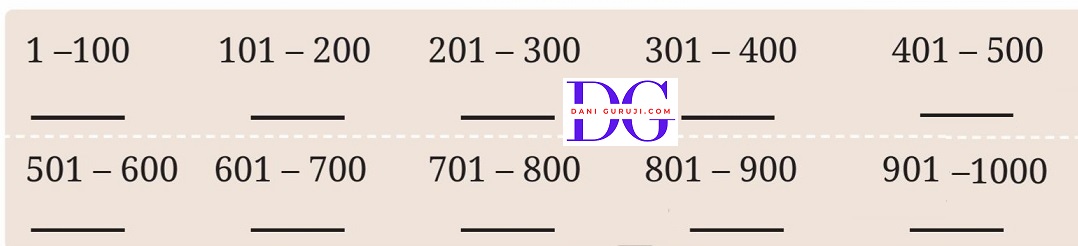
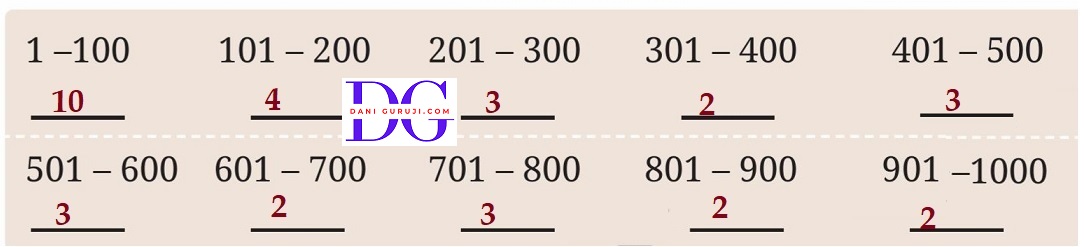
How many square numbers are there between 1 and 100? How many are between 101 and 200? Using the table of squares you filled earlier, enter the values below, tabulating the number of squares in each block of 100. What is the largest square less than 1000?
Solution :
The largest square less than 1000 is $31^2$ = 961.
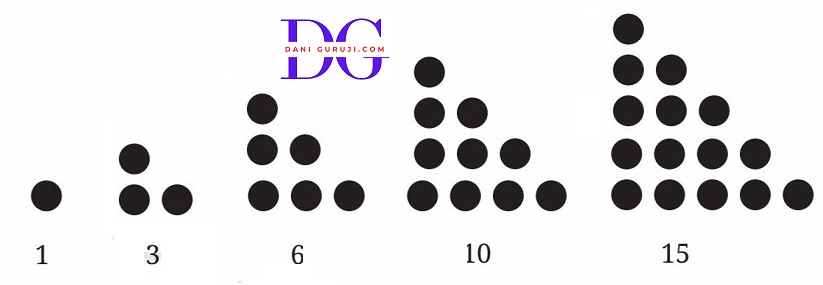
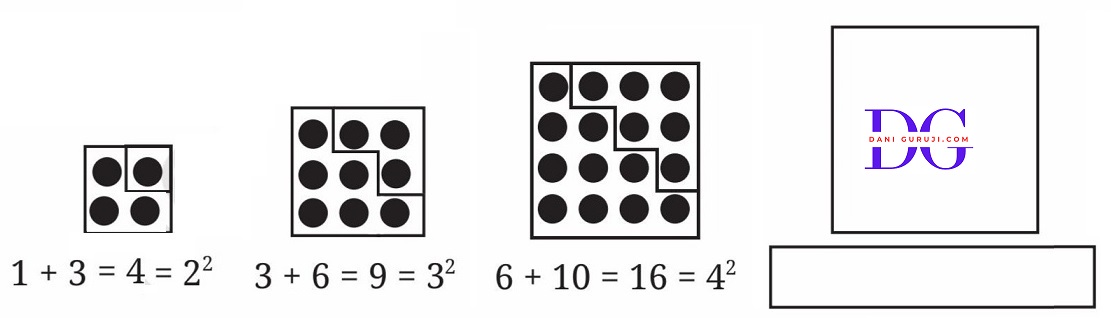
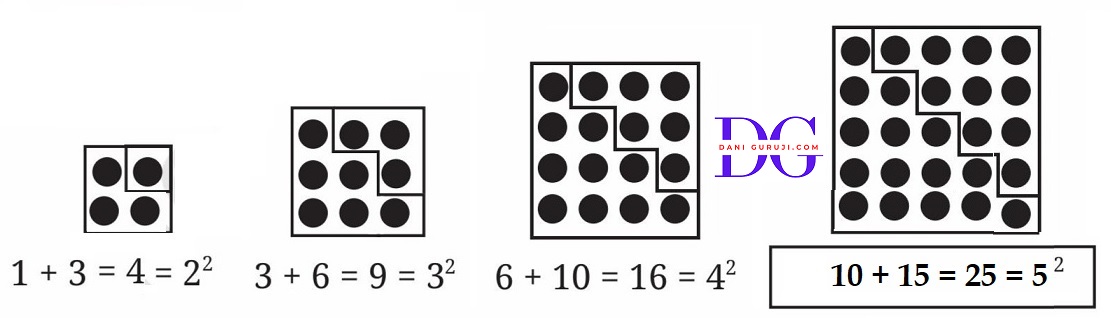
Can you see any relation between triangular numbers and square numbers? Extend the pattern shown and draw the next term.
Solution :
The sum of two consecutive triangular numbers is a perfect square.
1 + 3 = 4 = $2^2$
3 + 6 = 9 = $3^2$
6 + 10 = 16 = $4^2$
10 + 15 = 25 = $5^2$
Page 9 : Between Squares and Triangular Numbers
Find whether 1156 and 2800 are perfect squares using prime factorisation.
Solution :
To determine if a number is a perfect square using prime factorisation, we check if the exponent of every prime factor is an even number.
The prime factorization of 1156 is:
$1156 = 2 \times 2 \times 17 \times 17 = \mathbf{2^2 \times 17^2}$
Since the powers of all prime factors are even, 1156 is a perfect square.
$$\sqrt{1156} = 2 \times 17 = 34$$
The prime factorization of 2800 is:
$2800 = 2 \times 2 \times 2 \times 2 \times 5 \times 5 \times 7 = \mathbf{2^4 \times 5^2 \times 7^1}$
Since the prime factor 7 has an odd power, 2800 is NOT a perfect square
Therefore, 1156 is a perfect square and 2800 is NOT a perfect square.
Page 10 – 11 : Figure it Out
Which of the following numbers are not perfect squares?
(i) 2032
(ii) 2048
(iii) 1027
(iv) 1089
Solution :
A number is not a perfect square if its unit digit is 2, 3, 7, or 8.
(i) 2032 : Unit Digit is 2. So, it is not a perfect square.
(ii) 2048 : Unit Digit is 8. So, it is not a perfect square.
(iii) 1027 : Unit Digit is 7. So, it is not a perfect square.
(iv) 1089 : Unit Digit is 9. So, it Could be a perfect square.
For a number to be a perfect square, all exponents in its prime factorization must be even.
$$\mathbf{1089} = 33 \times 33 = \mathbf{33^2}$$
The only number in the list that is a perfect square is (iv) 1089.
Which one among ${64^2}$, ${108^2}$, ${292^2}$, ${36^2}$ has the last digit 4
Solution :
The last digit of a square is determined only by the last digit of the number being squared. A number's square will end in 4 if the number itself ends in 2 or 8, because:
$2 \times 2 = 4$
$8 \times 8 = 64$ (ends in 4)
Let's check the unit digit of each given number:
(i) ${64^2}$
Unit’s digit of 64 is 4
$4^2 = 16$ (last digit is 6)
(ii) ${108^2}$
Unit’s digit of 108 is 8
$8^2 = 64$ (last digit is 4)
So, $\mathbf{108^2}$ ends in 4
(iii) ${292^2}$
Unit’s digit of 292 is 2
$2^2 = 4$ (last digit is 4)
So, $\mathbf{292^2}$ ends in 4
(iv) ${36^2}$
Unit’s digit of 36 is 6
$6^2 = 36$ (last digit is 6)
The squares that have the last digit 4 are:$108^2$ and $292^2$
Given ${125^2}$ = 15625, what is the value of ${126^2}$ ?
(i) 15625 + 126
(ii) 15625 + ${26^2}$
(iii) 15625 + 253
(iv) 15625 + 251
(v) 15625 + ${25^2}$
Solution :
We are given $125^2 = 15625$ and want to find $126^2$.
Here, $n = 125$ and $n+1 = 126$.
The formula for the difference between two consecutive squares is:
$$(n+1)^2 - n^2 = 2n + 1$$
Therefore, the difference between $126^2$ and $125^2$ is:
$$126^2 - 125^2 = 2(125) + 1$$
$$126^2 - 125^2 = 250 + 1 = 251$$
To find $126^2$, we add this difference to $125^2$:
$$126^2 = 125^2 + 251$$
$$126^2 = 15625 + 251$$
The correct option is (iv) $15625 + 251$.
Find the length of the side of a square whose area is 441 ${m^2}$
Solution :
The area of a square is calculated using the formula:
$$\text{Area} = \text{side} \times \text{side} = s^2$$
$$s^2 = 441$$
Find the side length ($s$) by taking the square root of the area:
$$s = \sqrt{441}$$
$$s = \sqrt{3 × 3 × 7 × 7} $$
$$s = {21} $$
Therefore, the length of the side of the square is $21 \text{ m}$.
Find the smallest square number that is divisible by each of the following numbers: 4, 9, and 10.
Solution :
First, we find the LCM of 4, 9, and 10, as the square number must be a multiple of all three.
Prime Factorization:
$4 = 2 \times 2 = 2^2$
$9 = 3 \times 3 = 3^2$
$10 = 2 \times 5 = 2^1 \times 5^1$
The LCM is the product of the highest power of each prime factor involved (2, 3, and 5).
$$\text{LCM}(4, 9, 10) = 2^2 \times 3^2 \times 5^1= 180$$
We know, For a number to be a perfect square, the exponent of every prime factor in its prime factorization must be even.
The factor $5^1$ has an odd exponent (1).
So, To make the exponent of 5 even, we must multiply the LCM by 5.
$$\text{Smallest Square Number} = 180 \times 5$$
$$\text{Smallest Square Number} = \mathbf{900}$$
Find the smallest number by which 9408 must be multiplied so that the product is a perfect square. Find the square root of the product.
Solution :
Firstly, Finding the Smallest Multiplier.
First find prime factorization of 9408 :
Prime Factorization:
$$9408 = 2^2 \times 2^2 \times 2^2 \times \times 3^1 \times 7^2$$
We know, For a number to be a perfect square, the exponent of every prime factor in its prime factorization must be even.
The factor $3^1$ has an odd exponent (1)
$$\text{So , The smallest multiplier is } \mathbf{3}$$
Finding the Product.
So, To make the exponent of 3 even, we must multiply the 9408 by 3.
The product of $9408$ and the smallest multiplier ($3$) is $$ = 9408 \times 3 = \mathbf{28224}$$
$ \mathbf{28224}$ , which is a perfect square,
Finding the Square Root.
The square root of the product can be found by dividing all the exponents in the prime factorization of the product by $2$:
$\sqrt{{28224}} = \sqrt{2^2 \times 2^2 \times 2^2 \times \times 3^2 \times 7^2} $
$\sqrt{{28224}} = 2^{2 \div 2} \times 2^{2 \div 2} \times 2^{2 \div 2} \times 3^{2 \div 2} \times 7^{2 \div 2}$
$\sqrt{{28224}} = 8 \times 3 \times 7 = \mathbf{168}$
$$\text{The square root of the product is } \mathbf{168}$$
How many numbers lie between the squares of the following numbers?
(i) 16 and 17 (ii) 99 and 100
Solution :
For any two consecutive natural numbers, $n$ and $(n+1)$, the number of natural numbers lying between $n^2$ and $(n+1)^2$ is given by the formula $\mathbf{2n}$.
(i) Between the squares of 16 and 17
Here, the first number $n = 16$. The second number is $(n+1) = 17$
Using the formula, the number of numbers between $16^2$ and $17^2$ is
$$2n = 2 \times 16 = \mathbf{32}$$
Verification:
The squares are $16^2 = 256$ and $17^2 = 289$.
∴ Numbers lie between 256 and 289 is = (289 – 256) – 1 = 32
(ii) Between the squares of 99 and 100
Here, the first number $n = 99$. The second number is $(n+1) = 100$
Using the formula, the number of numbers between $16^2$ and $17^2$ is
$$2n = 2 \times 99 = \mathbf{198}$$
Verification:
The squares are $99^2 = 9801$ and $100^2 = 10000$.
∴ Numbers lie between 9801 and 1000 is = (1000 – 9801) – 1 = 198
In the following pattern, fill in the missing numbers:
(i) ${ 1^2 \times 2^2 \times 2^2 = 3^2}$
(ii) ${ 2^2 \times 3^2 \times 6^2 = 7^2}$
(iii) ${ 3^2 \times 4^2 \times 12^2 = 13^2}$
(iv) $4^2 \times 5^2 \times 20^2 = (\_\_\_)^2$
(v) $9^2 \times 10^2 \times (\_\_\_)^2 = (\_\_\_)^2$
Solution :
This pattern involves a relationship between three squared numbers being multiplied together, resulting in a fourth squared number.
The general rule for the pattern is:
$$n^2 \times (n+1)^2 \times [n(n+1)]^2 = [n(n+1) + 1]^2$$
(iv) Fourth Row: $4^2 \times 5^2 \times 20^2 = (\_\_\_)^2$
Here, the first number $n = 4$. The second number is $(n+1) = 5$
The third term's base is $4 \times 5 = 20$.
The fourth term's base (the missing number) is $20 + 1 = \mathbf{21}$.
$$4^2 \times 5^2 \times 20^2 = \mathbf{21}^2$$
(v) Fifth Row: $9^2 \times 10^2 \times (\_\_\_)^2 = (\_\_\_)^2$
Here, the first number $n = 9$. The second number is $(n+1) = 10$
The third term's base is $9 \times 10 = 90$.
The fourth term's base (the missing number) is $90 + 1 = \mathbf{91}$.
$$9^2 \times 10^2 \times \mathbf{90}^2 = \mathbf{91}^2$$
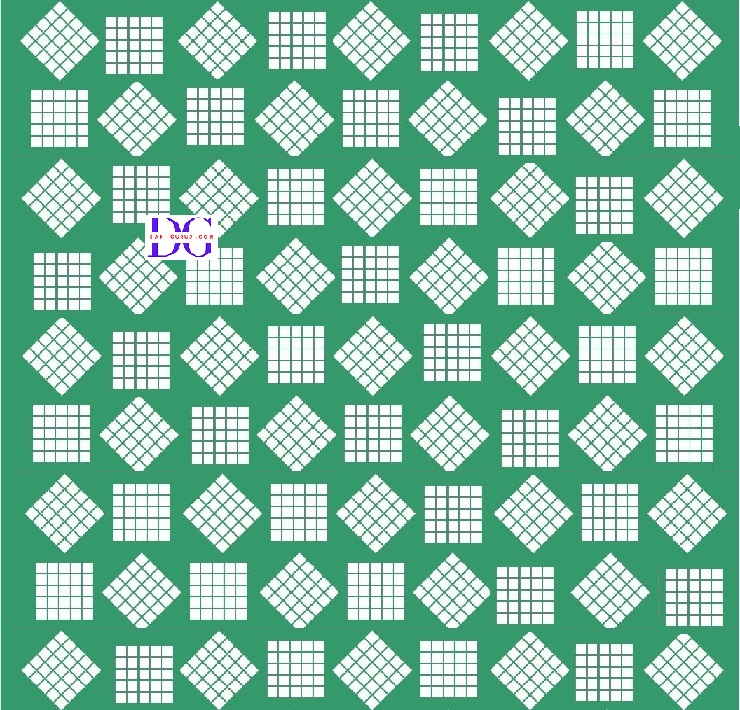
How many tiny squares are there in the following picture? Write the prime factorisation of the number of tiny squares.
Solution :
Number of squares in a row = 9.
Number of squares in a column = 9.
Number of tiny squares in a square's row = 5.
Number of tiny squares in a square's column = 5.
Total number of tiny squares in the square = 5 × 5 = 25.
Total number of tiny squares in the picture = 5 × 5 × 9 × 9 = 2025.
Prime factorization of 2025:
2025 = (3 × 3) × (3 × 3) × (5 × 5)
Page 12
Complete the table below.
Solution :
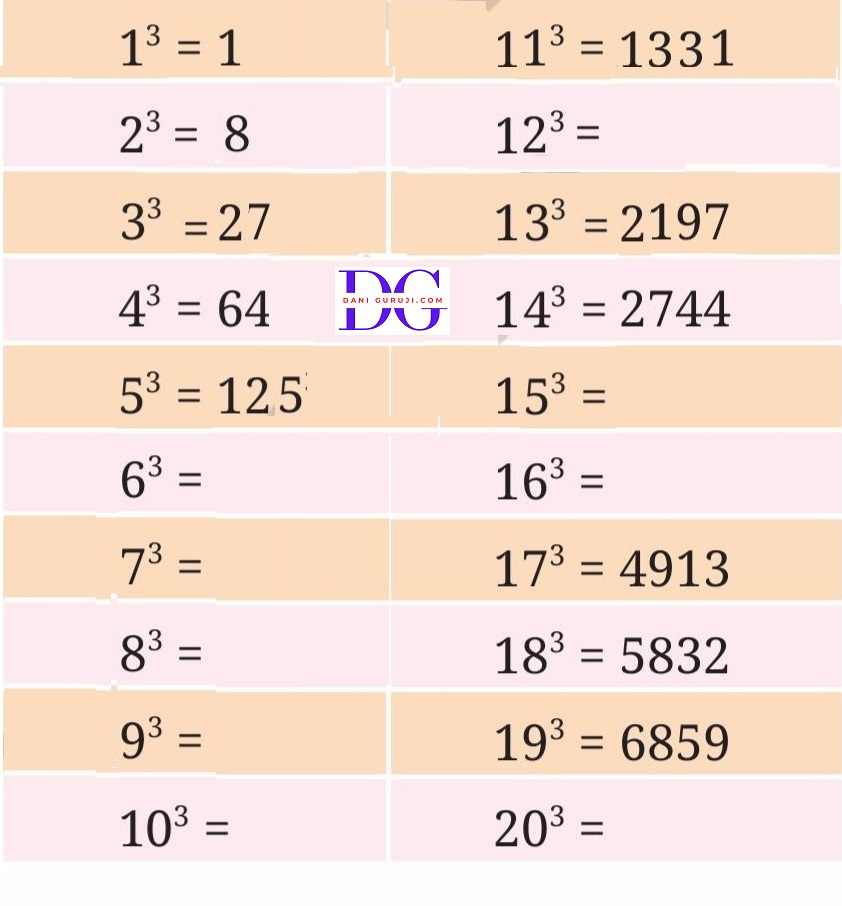
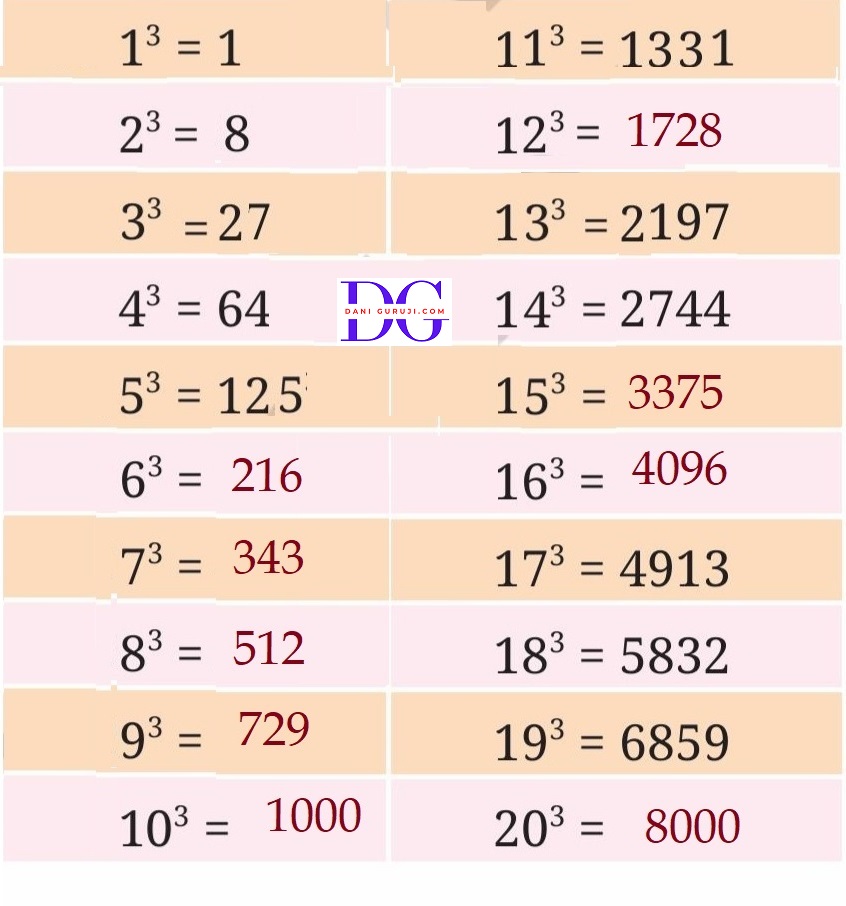
What patterns do you notice in the table above?
Solution :
The cubes of numbers ending in 0 will have at least three zeros at the end.
Numbers ending in 0, 1, 4, 5, 6, or 9 have cubes that end in the same digit.
The last digits of the numbers 2, 3, 7, and 8 have a relationship with the last digit of their cubes:
Numbers ending in 2 have cubes ending in 8.
Numbers ending in 8 have cubes ending in 2.
Numbers ending in 3 have cubes ending in 7.
Numbers ending in 7 have cubes ending in 3.
The cube of an odd number is always an odd number (e.g., $3^3 = 27$, $5^3 = 125$).
The cube of an even number is always an even number (e.g., $2^3 = 8$, $4^3 = 64$).
We know that 0, 1, 4, 5, 6, 9 are the only last digits possible for squares. What are the possible last digits of cubes?
Solution :
The possible last digits of cubes are all ten digits from 0 to 9.
Unlike perfect squares, which can only end in 0, 1, 4, 5, 6, or 9, the units digit of a perfect cube can be any single digit.
we find that each of the ten possible digits appears exactly once as the units digit of a cube.
Page 13
Similar to squares, can you find the number of cubes with 1 digit, 2 digits, and 3 digits? What do you observe?
Solution :
1-digit cubes:
$1^3=1, 2^3=8$
Number of 1-digit Cubes : 2
2-digit cubes:
$3^3=27, 4^3=64$
Number of 2-digit Cubes : 2
3-digit cubes:
$5^3=125, 6^3=216, 7^3=343, 8^3=512, 9^3=729$
Number of 5-digit Cubes : 5
Observation: The number of 1-digit and 2-digit cubes is very small, only two for each. This is much less than the counts for squares. The number of perfect cubes increases as the numbers get larger.
Can a cube end with exactly two zeroes (00)? Explain.
Solution :
No, a perfect cube cannot end with exactly two zeroes (00), because zeros in a cube occur in multiples of three.
The Case of Two Zeroes: Since $2$ is not a multiple of 3, it is impossible for a perfect cube to end with exactly two zeroes.
Example:
A number ending in one zero (like $10$) has $10^3 = 1000$ (3 zeroes).
A number ending in two zeroes (like $100$) has $100^3 = 1,000,000$ (6 zeroes).
The next two taxicab numbers after 1729 are 4104 and 13832. Find the two ways in which each of these can be expressed as the sum of two positive cubes.
Solution :
Taxicab numbers (or $Ta(n)$) are defined as the smallest number that can be expressed as the sum of two positive cubes in $n$ distinct ways.
1. Taxicab Number: 4104
The number 4104 can be expressed as the sum of two positive cubes in the following two ways:
First : $16^3 + 2^3$
$ 4096 + 8 = 4104$.
Second : $15^3 + 9^3$
$3375 + 729 = 4104$.
2. Taxicab Number: 13832
The number 13832 can be expressed as the sum of two positive cubes in the following two ways:
First : $24^3 + 2^3$
$ 13824 + 8 = 13832$.
Second : $20^3 + 18^3$
$8000 + 5832 = 13832$.
Page 15
Find the cube roots of these numbers:
(i)$\sqrt[3]{64} $
(ii) $\sqrt[3]{512} $
(iii) $\sqrt[3]{729} $
Solution :
(i)$\sqrt[3]{64} $
Prime factorisation : Group the factors into triplets
64 = (2 × 2 × 2) × (2 × 2 × 2)
= $2^3 × 2^3 $
= $ { ( 2 × 2)}^3 $
= $4^3 $
∴ Cube root = $\sqrt[3]{64} = 4$
(ii)$\sqrt[3]{512} $
Prime factorisation : Group the factors into triplets
512 = (2 × 2 × 2) × (2 × 2 × 2)× (2 × 2 × 2)
= $2^3 × 2^3 × 2^3 $
= $ { ( 2 × 2 × 2)}^3 $
= $8^3 $
∴ Cube root = $\sqrt[3]{512} = 8 $
(i)$\sqrt[3]{729} $
Prime factorisation : Group the factors into triplets
729 = (3 × 3 × 3) × (3 × 3 × 3)
= $3^3 × 3^3 $
= $ { ( 3 × 3)}^3 $
= $9^3 $
∴ Cube root = $\sqrt[3]{729} = 9$
Page 16 Figure it Out
Find the cube roots of 27000 and 10648.
Solution :
(i)$\sqrt[3]{27000} $
Prime factorisation : Group the factors into triplets
27000 = (2 × 2 × 2) × (3 × 3 × 3)× (5 × 5 × 5)
= $2^3 × 3^3 × 5^3$
= $ { ( 2 × 3 × 5)}^3 $
= $30^3 $
∴ Cube root = $\sqrt[3]{27000} = 30$
(ii)$\sqrt[3]{10648} $
Prime factorisation : Group the factors into triplets
10648 = (2 × 2 × 2) × ( 11 × 11 × 11)
= $2^3 × 11^3 $
= $ { ( 2 × 11)}^3 $
= $22^3 $
∴ Cube root = $\sqrt[3]{10648} = 22 $
What number will you multiply by 1323 to make it a cube number?
Solution :
First, we find the prime factorization of 1323:
Prime factorisation :
$$1323 = 3 \times 3 \times 3 \times 7 \times 7$$
$$1323 = 3^3 \times 7^2$$
For a number to be a perfect cube, the exponent of every prime factor in its factorization must be a multiple of 3.
When you multiply 1323 by 7, you get the perfect cube:
$$1323 \times 7 = (3^3 \times 7^2) \times 7$$
$$1323 \times 7 = 3^3 \times 7^3$$
$$9261 = (3 \times 7)^3 = 21^3$$
$$9261 = 21^3$$
∴ Hence, the number by which 1323 needs to be multiplied to make it a cube number is 7
State true or false. Explain your reasoning.:
(i) The cube of any odd number is even.
(ii) There is no perfect cube that ends with 8.
(iii) The cube of a 2-digit number may be a 3-digit number.
(iv) The cube of a 2-digit number may have seven or more digits.
(v) Cube numbers have an odd number of factors.
Solution :
(i) The cube of any odd number is even
False
The product of odd numbers is always odd. For any odd number $n$, $n \times n \times n$ will always be odd.
Example: $3^3 = 27$ (odd).
(ii) There is no perfect cube that ends with 8
False
The cube of any number ending in 2 will end in 8.
Example: $2^3 = 8$ and $12^3 = 1728$.
(iii) The cube of a 2-digit number may be a 3-digit number
False
The smallest 2-digit number is 10. $10^3 = 1000$, which is a 4-digit number.
All other 2-digit numbers have cubes greater than 1000.
(iv) The cube of a 2-digit number may have seven or more digits.
False
The largest 2-digit number is 99. $99^3 = 970,299$. This is a 6-digit number.
The largest possible cube of a 2-digit number is $99^3 < 100^3 = 1,000,000$ (7 digits).
(v) Cube numbers have an odd number of factors
False
Only perfect squares have an odd number of factors.
Cube numbers can have either an odd or an even number of factors.
Example: $8$ (a cube: $2^3$) has factors $\{1, 2, 4, 8\}$, which is 4 factors (even).
You are told that 1331 is a perfect cube. Can you guess without factorisation what its cube root is? Similarly, guess the cube roots of 4913, 12167, and 32768.
Solution :
Yes, you can efficiently guess the cube roots of these perfect cubes without using prime factorization, by applying the units digit rule and estimation based on the grouping of digits.
(1) Cube Root of 1331
The number 1331 ends in 1. The cube root must also end in 1 (since $1^3 = 1$)
Ignore the last three digits (331) and look at the remaining number, 1.
Since $1^3 = 1$ and $2^3 = 8$, the largest cube less than or equal to 1 is $1^3$. The tens digit is 1.
Combining the digits gives 11.
$$\sqrt[3]{1331} = 11$$
(2) Cube Root of 4913
The number 4913 ends in 3. The cube root must end in 7 (since $7^3 = 343$, which ends in 3).
Ignore the last three digits (913) and look at the remaining number, 4.
Here, $1^3 = 1$ and $2^3 = 8$, Since $1 < 4 < 8$, we take the smaller base, 1, as the tens digit.
Combining the digits gives 17.
$$\sqrt[3]{4913} = 17$$
(3) Cube Root of 12167
The number 12167 ends in 7. The cube root must end in 3 (since $3^3 = 27$, which ends in 7).
Ignore the last three digits (167) and look at the remaining number, 12
Here, $2^3 = 8$ and $3^3 = 27$ . Since $8 < 12 < 27$, we take the smaller base, 2, as the tens digit.
Combining the digits gives 23.
$$\sqrt[3]{12167} = 23$$
(4) Cube Root of 32768
The number 32768 ends in 8. The cube root must end in 2 (since $2^3 = 8$).
Ignore the last three digits (768) and look at the remaining number, 32.
Here, $3^3 = 27$ and $4^3 = 64$. Since $27 < 32 < 64$, we take the smaller base, 3, as the tens digit.
Combining the digits gives 32.
$$\sqrt[3]{32768} = 32 $$

Which of the following is the greatest? Explain your reasoning.
(a) $67^3 - 66^3$
(b) $43^3 - 42^3$
(c) $67^2 - 66^2 $
(d) $43^2 - 42^2 $
Solution :
(i) Difference of Cubes vs. Difference of Squares
In general, for any number $n > 1$:
$$n^3 > n^2$$
Therefore, the difference between consecutive cubes will be significantly larger than the difference between consecutive squares, especially for larger numbers:
This immediately tells us that (a) $67^3 - 66^3$ and (b) $43^3 - 42^3$ will be greater than (c) $67^2 - 66^2$ and (d) $43^2 - 42^2$.
Comparing the Two Cube Differences
We can use the algebraic identity for the difference of cubes: $a^3 - b^3 = (a-b)(a^2 + ab + b^2)$
(a) $67^3 - 66^3 = 1 \cdot (67^2 + 67 \cdot 66 + 66^2)$
(b) $43^3 - 42^3 = 1 \cdot (43^2 + 43 \cdot 42 + 42^2)$
Since $67$ and $66$ are much larger numbers than $43$ and $42$,
the sum of their squares and product will be much greater.
Therefore, (a) $67^3 - 66^3$ is the greatest.
Syllabus for class 10
Advanced courses and exam preparation.
Previous Year Paper
Advanced courses and exam preparation.
Mock Test
Explore programming, data science, and AI.